
The Wolf and Its Habitat
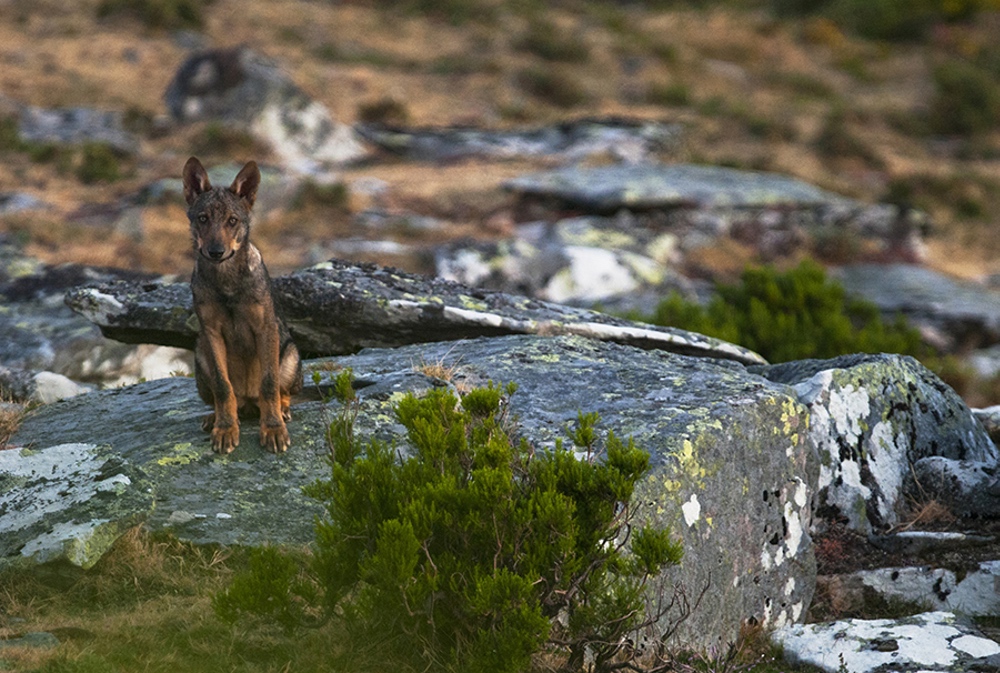
The wolf (Canis lupus, Linnaeus 1758) is a mammal of the canid family. A large carnivore, surpassed in Europe only by the brown bear, it is the largest wild canid currently existing. The Iberian wolf (Canis lupus signatus, Cabrera 1907) is the endemic subspecies of the Iberian Peninsula. In Portugal, it has the conservation status of "Endangered" (EN) and is considered a priority species.
The Iberian wolf is characterized by being smaller than the wolf found in the rest of Europe and by its more yellowish-brown coat. The change to the summer coat occurs at the beginning of spring, with a reduction in the density and length of the fur, and in October the change to the winter coat begins. The winter coat becomes denser and longer, giving the wolf greater resistance to the weather conditions of autumn and winter and a more robust appearance.
Its back features a black stripe that extends from the withers to the tail. Its forelimbs also have a well-defined black stripe. Weighing between 25 and 40 kg as an adult, the Iberian wolf is also characterized by strong and robust limbs, a large head with triangular and rigid ears.
The breeding season begins in early spring, and the offspring are born in May/June.
In summer, the maximum number of individuals per pack is reached. Winter represents a challenge for the survival of the Iberian wolf, characterized by a minimum number of individuals per pack.
The wolf has a great capacity for adaptation, appearing in practically all habitats in the Northern Hemisphere. From the most remote environments to those close to urban areas, the wolf is present in the most varied types of habitat. It is a generalist animal in its habitat selection, depending essentially on the availability of food and human behavior.
The mountainous regions of northern and north-central Portugal are the stronghold of the Iberian wolf in Portugal. The low population densities in these regions, combined with some food availability, provide conditions favorable to the presence of this carnivore.
Although the mountainous regions in Portugal do not have very high altitudes, conditions are difficult and marked by a reduced availability of food.
The Iberian wolf's feeding behavior is generalist, with ungulates forming the basis of its diet.
Ungulates are the preferred wild prey of the wolf. In Portugal, the roe deer (Capreolus capreolus), the wild boar (Sus scrofa), and the red deer (Cervus elaphus) are the three main ungulate species that make up the Iberian wolf's diet, and their importance varies from region to region. The Iberian ibex (Capra pyrenaica), present in the Peneda-Gerês mountains, is gradually expanding and may become another important wild prey for the wolf in the future.
The roe deer, considered by many researchers to be the main natural prey of the Iberian wolf, occurs primarily in the North and Central regions of Portugal, largely overlapping with the current distribution area of the wolf.
Wild boar are a species found throughout the continental territory, with highly variable densities depending on the type of habitat and hunting management practices. They constitute a significant natural prey for wolves, due to their presence throughout the wolf's distribution area.
The red deer is the largest cervid in the national fauna. Its natural populations in Portugal partly coincide with the current distribution of the Iberian wolf, with particular emphasis on the Bragança district.
The Iberian wolf has a characteristic social behavior, marked by the formation of highly hierarchical groups – packs. The number of these packs can vary depending on, among other variables, the quantity and size of prey found in their territory. The space used by a pack also varies according to the availability and abundance of prey.
In Portugal, the territories of the Iberian wolf can vary between 50 and 300 km2. Due to their elusive behavior and primarily nocturnal activity, wolves are difficult to spot in their natural habitat.
DISTRIBUTION IN PORTUGAL
At the beginning of the 20th century, the Iberian wolf was relatively common and occupied various territories from north to south of Portugal. Currently, this canid has a much smaller distribution (approximately 20,400 km2) that only includes the region north of the Douro River and a smaller area south of this river, in the north-central region, giving rise to two sub-populations.
The sub-population north of the Douro River has a range of approximately 13,600 km2 and is in contact with the Spanish population. According to the 2002/03 National Wolf Census, this sub-population comprises 54 packs.
The sub-population south of the Douro River has a more restricted area (6,800 km2) with apparent isolation from the rest of the population. According to the 2002/03 National Wolf Census, this sub-population has no more than 9 packs.
Generally speaking, the species occurs in mountainous areas of these regions, reflecting a lower human population density and less intensive agricultural activity in these locations.
MAN-WOLF RELATIONSHIP
Humans play a decisive role in the distribution, ecology, and behavior of the wolf. However, the reverse is equally true. From the earliest hominids to the present day, there are numerous historical and cultural records of this interaction. Cave paintings, legends, fables, religious representations, livestock guardian dogs, and wolf traps are clear examples of the influence this animal has on humans.
Predation on domestic animals (cattle, horses, sheep, and goats) is one of the biggest problems in the conservation of this carnivore, especially in areas with reduced or absent populations of wild prey. Several measures exist to protect domestic animals from wolf attacks, such as livestock guardian dogs, monitored grazing, and appropriate forms of confinement for domestic animals, which have proven effective in minimizing the impact of predation.